
UBS Acquired Credit Suisse: Was Justice Served?
The rescue of Credit Suisse took a weekend; the legal reckoning is in its fourth year. Switzerland's highest court has upheld the emergency law and the cancelled bonuses, while AT1 bondholders and some 3,000 shareholders still wait for their day in court. Was justice served, or only stability? We are analyzing the aftermath of the most spectacular bank collapse in history.
NOVEMBER 16, 2026. FILIA PATER. APPR. 9 MIN.
Justice in Judge Erb's Chambers
In chapter 34 of Conspiracy Suisse, Peter Winzeler stands before Judge Jana Erb with a binder of evidence against SWB's chief executive. The bank's general counsel protests furiously. The judge silences them both: "the concept of 'justice' still has weight in my chambers," she says. Then she dismisses Winzeler's claim. The evidence, she rules, is circumstantial; perhaps his clients "should have protected their interests better earlier." The CEO walks out unpunished, and justice, in the novel, must find another route.
Real life has been no less ambiguous. The rescue of Credit Suisse took a single weekend. The legal reckoning is now in its fourth year, spread across courtrooms in St. Gallen, Lausanne, Zurich and New York. Some cases have been decided. The largest are still open.
This is Part 6 of our series "Credit Suisse, UBS, and Switzerland's Future". In Part 3 we asked who benefited from the collapse. Today we ask the harder question: when the state, the regulator and UBS rewrote the rules over a weekend in March 2023, was justice served? We follow the money through four groups: the shareholders, the bondholders, the managers, and UBS itself, which inherited all of Credit Suisse's sins along with its assets.

Rescue by Decree: The Emergency Law
To understand the legal battles, start with how the deal was done. Under ordinary Swiss law, a merger of this size would have required shareholder votes, merger reports, waiting periods and, quite possibly, parliamentary approval for the state guarantees. There was no time for any of it. The Federal Council invoked its constitutional emergency powers under Articles 184 and 185 and issued an emergency ordinance that, among other things, set aside the shareholders' rights to information and participation.
Was that legal? Switzerland's highest court has now answered twice. In a decision of 7 October 2025, published in September 2026, the Federal Supreme Court dismissed a shareholder's damages claim against the Confederation and upheld the use of emergency law. The judges accepted the government's view that the potential damage, estimated at around 150% of Swiss GDP, justified bypassing ordinary procedures. They found that putting the interests of the country ahead of shareholders' participation rights was neither arbitrary nor a breach of duty. And they noted something that matters for what comes next: it was UBS, not the government, that set the price, and the property guarantee in the Constitution protects legal rights, not the market value of shares in a crisis.
In other words, the courts have given the state a wide margin to act in an emergency. Whether that margin is wise is a political question; the judges explicitly declined to review the "expediency" of the government's choices. But it leaves one door open. The Supreme Court stressed that the emergency ordinance did not remove shareholders' right to have the price reviewed in court. That review is still pending.
The Bondholders: CHF 16.5 Billion in Limbo
The AT1 case is the one the whole financial world is watching. On the night of the rescue, FINMA ordered the complete write-off of Credit Suisse's AT1 bonds, about CHF 16.5 billion, while shareholders still received UBS stock. Around 3,000 bondholders went to the Federal Administrative Court in St. Gallen. In October 2025, in a pilot case, that court found the write-off unlawful. Its reasoning was striking: the contractual trigger for a write-off, a "viability event", had not occurred, because Credit Suisse was still adequately capitalised. The state support was aimed at liquidity, not at replenishing capital.
FINMA and UBS appealed. The Federal Supreme Court has suspended the lower ruling until it decides, so the bonds remain worthless for now, and a final judgment could take years. Bondholders who wanted to keep other options open had to act before 19 March 2026 to stop the statute of limitations from running out. Abroad, the doors have mostly closed: in July 2026, a US appeals court ruled that Switzerland had acted as a sovereign and enjoys immunity from a USD 370 million claim. Investment-treaty arbitration claims against Switzerland are still pending.
There is a telling parallel from India. On 15 October 2026, India's Supreme Court made final the reversal of Yes Bank's AT1 write-off, ruling that the bank's reconstruction scheme did not permit it. The legal systems and facts differ, and commentators caution that each case stands on its own. But the question is the same in Mumbai and Lausanne: can a state, in an emergency, wipe out a class of creditors that its own rules say should not yet have been touched? If the Swiss court says no, someone, possibly FINMA, the Confederation or UBS, may face a bill in the billions.

The Shareholders: A Price Set Over a Weekend
Credit Suisse shareholders received one UBS share for every 22.48 Credit Suisse shares, about CHF 0.76 each, valuing the bank at roughly CHF 3 billion. On the Friday before the deal, the market had valued it at about CHF 7 billion. The shareholders were never asked.
Swiss merger law gives them one remedy: Article 105 of the Merger Act lets shareholders ask a court to review whether the exchange ratio was adequate. Several groups did so before the August 2023 deadline, including the start-up LegalPass with some 3,000 shareholders backed by the Ethos Foundation, the Swiss Investor Protection Association, and the Liechtenstein firm Lennert Partners. The case before the Zurich Commercial Court is enormous: according to lawyers at Prager Dreifuss, the amount in dispute is CHF 50 billion. Valuation reports filed by plaintiffs put the fair value of a Credit Suisse share at between CHF 3.67 and 9.26, or even up to CHF 10.01, against the CHF 0.76 paid.
UBS's answer is simple and not easily dismissed: without the merger, Credit Suisse would have collapsed and its shareholders would have lost everything. The plaintiffs reply that a bank must be valued as a going concern, as it in fact continued inside UBS, not as a hypothetical bankruptcy. Both arguments rest on a counterfactual nobody can prove: what would Credit Suisse have been worth on Monday morning if the state had not intervened?
There is a precedent worth recalling. When JPMorgan bought Bear Stearns in a forced sale in 2008, it initially offered USD 2 a share. After a shareholder revolt, it raised the price to USD 10 within days. Credit Suisse shareholders are still waiting, three and a half years on.
The Managers: Bonuses, Lawsuits and the Missing Verdict
If one number explains public anger in Switzerland, it is this one. Between 2010 and 2022, Credit Suisse paid its staff CHF 39.8 billion in variable compensation while accumulating losses of CHF 33.7 billion and paying CHF 15 billion in fines, settlements and damages.
In May 2023, the finance ministry ordered the cancellation or reduction of outstanding bonuses for the top three management levels, affecting around 1,000 people. Twelve of them challenged it, and in 2025 the Federal Administrative Court ruled the cuts unlawful, treating the bonuses as contractual claims protected by the guarantee of property. On 15 October 2026, the Federal Supreme Court overturned that ruling. The Banking Act, it found, does allow bonuses to be cancelled when a bank receives state aid. With a CHF 100 billion federal guarantee on the line, there was a strong public interest in ensuring that rewards for the years that "laid the groundwork" for the crisis were not paid with public money. The measure was proportionate.
That is a rare clear verdict. Elsewhere, accountability has come mostly through settlements. In New York, 19 former Credit Suisse directors and executives, including former chairman Urs Rohner, agreed to a USD 115 million settlement of a shareholder suit over failed risk management, paid by their insurers to UBS. In Switzerland, the Office of the Attorney General opened an investigation into the takeover in April 2023, and in November 2025 it indicted Credit Suisse and UBS as its successor over alleged money laundering linked to the Mozambique affair, along with a former compliance employee. UBS rejects the allegations.
What is missing is the verdict the public seems to want most: a court finding that the people who ran Credit Suisse into the ground are personally responsible for its fall. Today's Swiss law offers few tools to pin a bank's failure on named individuals. The senior managers regime now being drafted, which we described in Part 2, is meant to change that for the future. It cannot change the past.

UBS: Heir to Every Sin
There is an irony at the centre of all this litigation. The party that most often stands in court today is not Credit Suisse, which no longer exists, but UBS, its legal successor. UBS defends the AT1 write-off it benefited from, the exchange ratio it set, and the indictments for conduct that happened years before it owned the bank. It also collects: the USD 115 million paid by former Credit Suisse executives' insurers goes to UBS, not to the shareholders who lost their savings.
The inherited list is long, as we described in Part 1: Archegos fines, the Mozambique tuna bonds, US tax cases, mortgage-bond obligations and a stream of smaller settlements. In the United States, securities class actions by former Credit Suisse investors have certified classes and continue, according to UBS's annual report.
Is that fair to UBS? In one sense, yes: it knew what it was buying, it paid a fraction of book value, and as we showed in Part 3, it booked a gain of nearly USD 28 billion that was meant precisely to absorb these costs. In another sense, the takeover blurred the line between the people who caused the damage and those who now pay for it. Most of Credit Suisse's former managers kept what they had already been paid. UBS's shareholders, and potentially Swiss taxpayers if the AT1 case goes against the state, are left with the bill.
Law and Justice in the Novel
Conspiracy Suisse is, among other things, a novel about the gap between law and justice. Its hero is a lawyer whose father, an insolvency specialist, had built his career, as the novel puts it, as "a high-end debt collector for the rich and powerful", and who made his son promise to choose "righteousness over fortune". Peter Winzeler loses his case before Judge Erb because the law demands proof he cannot produce. He wins in the end only by stepping outside the courtroom: he confronts the chief executive with evidence and forces him to resign, "no golden parachute, no bonus".
The novel is honest about the price of that. Its heroes bend rules, threaten opponents and, in the final chapter, the Grand Master places a gun on the table to persuade a reluctant general counsel to sign. Fiction allows such shortcuts. A state governed by law does not, and should not. The real Swiss courts have done what courts are supposed to do: slowly, and with deference to a government acting in an emergency, they have tested every decision against the law. Some of their answers will satisfy a public that wants bankers punished. Others will not.
There is a line in chapter 8 that captures the mood many Swiss still feel. The journalist Lilith Bahti says of bankers that "they never seem to be held accountable for their actions, even when they drive the economy into the ground."
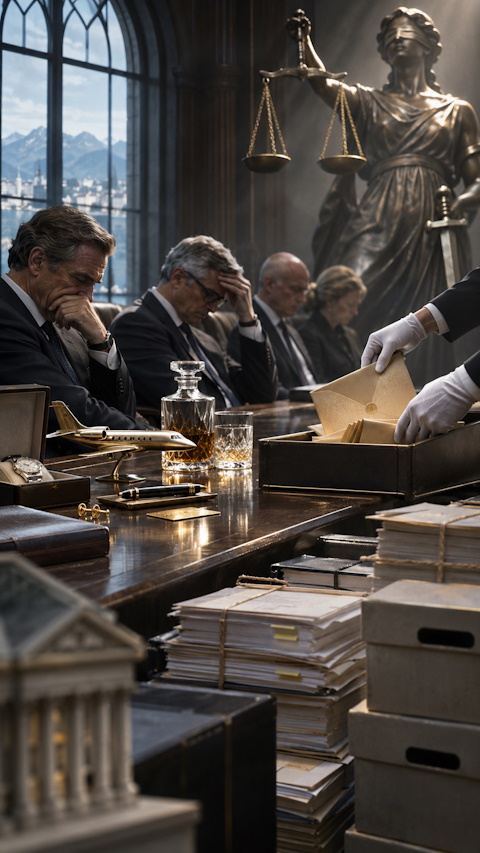
Was Justice Served?
On the narrow question of legality, the state has so far won every important round. The courts have accepted that a real emergency justified extraordinary measures, and that public money should not reward the managers who made it necessary. That is not nothing.
But justice is more than legality. It also asks whether losses fell on those who took the risks and made the decisions. On that measure, the verdict is still open. The two groups with the strongest claim to have been treated unfairly, the bondholders who were wiped out ahead of shareholders and the shareholders who were paid a price no court has yet tested, are still waiting. Their cases will decide whether Switzerland's rescue is remembered as a hard but lawful necessity, or as a weekend when the rule of law was quietly set aside for the sake of stability.
Epilogue
Next in Series: What Happens if UBS Fails?
In Conspiracy Suisse, Judge Erb tells the lawyers that justice still has weight in her chambers. The Federal Supreme Court in Lausanne will soon show how much it weighs in Switzerland's. This website informs about topics that are touched upon in the novel. In this series of articles, we are looking at the real events that unfolded after the collapse of Credit Suisse in detail. If you want to see how a novelist imagined it all before it happened, start with the questions the book raises. You can read the first five chapters of the novel for free if you wish.
Sources
- Swiss Supreme Court dismisses another state liability claim (IFLR/Prager Dreifuss, Sep 2026)
- Swiss pension funds brace for AT1 court fight (IPE)
- Federal Supreme Court to review FINMA write-off (Lexology)
- AT1 investors face claims deadline (IPE)
- US appeals court upholds Swiss sovereign immunity (finews)
- Yes Bank AT1 bond controversy (Wikipedia)
- Ethos supports LegalPass action against the exchange ratio (Ethos)
- Calls for independent appraisal grow louder (finews.asia)
- Complaints from CS shareholders advance (finews.asia)
- UBS/Credit Suisse not the first forced bank merger to land in court (finews)
- No bonus reductions for former CS managers (Federal Administrative Court)
- Bonuses for former CS executives were rightly cut (finews, 15 Oct 2026)
- UBS reaches $115 million derivatives-related settlement (WealthBriefing)
- Former Credit Suisse employee charged with money laundering (Swissinfo)
- Swiss prosecutor investigates Credit Suisse takeover (Swissinfo)
- UBS Group 2025 annual report, Form 20-F (SEC)
Series: Credit Suisse, UBS, and Switzerland's Future
Forum Topic: Swiss Banking and the Collapse of Credit Suisse
Tags: UBS, Credit Suisse, banking
Comments
Leave a comment