Credit Suisse Is Dead. Could UBS Be Next?
Credit Suisse is dead. Three years on, the bank that swallowed it is bigger than ever, and so are its problems: inherited scandals, a court fight over CHF 16 billion of wiped-out bonds, and a capital dispute that has UBS openly weighing a life outside Switzerland. We are analyzing the aftermath of the most spectacular bank collapse in history.
NOVEMBER 11, 2026. FILIA PATER. APPR. 10 MIN.
A Morning on Paradeplatz
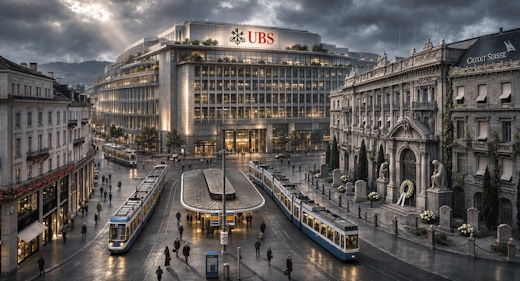
The trams still ring their bells across Paradeplatz at nine o'clock sharp. They rang the same way on the morning a fictional Grand Master named Claude Henri de Grimavi marched across the square, his two brothers in triangular formation behind him, to reclaim a bank. Yet one thing about the square has changed for good. For 167 years, the building at Paradeplatz 8 stood for Credit Suisse. Since the weekend of 19 March 2023, it has belonged to UBS.
When the first chapters of Conspiracy Suisse were written in 2018, the idea that Switzerland's second-largest bank could vanish in a single weekend sounded like something only a thriller writer would dare to invent. Five years later, it happened. Credit Suisse is dead. That much is settled.
The harder question is the one Swiss dinner tables keep returning to: could the bank that swallowed it be next? Not necessarily next to collapse. "Next" can also mean next to be moved abroad, sold, broken up, or quietly hollowed out until it is Swiss in name only. In the novel, the bank at the centre of the conspiracy, SWB, is deliberately the single largest bank in the country. Only time will tell whether its story is about Credit Suisse or about UBS.
This article is the first in a series called "Credit Suisse, UBS, and Switzerland's Future" where we will analyze the aftermath of the collapse of Credit Suisse as events unfold: the courtroom battles, the capital fight in Bern, the question of where UBS will call home, and what it all means for Swiss banking. We begin with the big picture: where the giant stands today, and where it is exposed.

How Credit Suisse Died in a Weekend
Alfred Escher founded the Schweizerische Kreditanstalt in 1856 to finance Swiss railways with Swiss money, precisely so that foreigners would not steer the country's infrastructure. For a century and a half, it was the pride of Paradeplatz. Then came the acquisitions, the Wall Street culture, and a parade of scandals that readers of Conspiracy Suisse will recognise in thinly veiled form: spying on former executives, the Mozambique "tuna bonds", drug money from a Bulgarian cocaine gang, the Suisse Secrets leak, and in 2021 the twin disasters of Archegos and Greensill. We have told that story in detail in Fascinating Misfortune of Credit Suisse.
The end, when it came, was brutally fast. In March 2023, panic over Silicon Valley Bank spread across the Atlantic. The Saudi National Bank, Credit Suisse's largest shareholder, refused to inject more capital. Clients withdrew billions within days. On Sunday 19 March, under pressure from the Swiss government, UBS agreed to buy its old rival for about CHF 3 billion, backed by state support worth roughly CHF 260 billion.
In the same stroke, the regulator FINMA ordered the complete write-off of Credit Suisse's Additional Tier 1 (AT1) bonds, about CHF 16.5 billion wiped out overnight, while shareholders still received UBS stock. Shareholders were not asked to vote; emergency law took care of that. It was the most spectacular bank collapse in history, and it was over before the Asian markets opened on Monday.
The Giant That Was Born: UBS Is Twice the Size of Switzerland
By the numbers, the new UBS is a triumph. In the third quarter of 2026 it reported a net profit of USD 2.7 billion, USD 55 billion of fresh wealth-management money in three months, and invested assets of USD 7.3 trillion. Its balance sheet stood at about USD 1.66 trillion at the end of September. The integration is nearly done: around 1.2 million former Credit Suisse clients were migrated onto UBS systems by March 2026.
And there lies the problem. A bank that size sits in a country of nine million people. By one widely cited estimate, UBS's balance sheet is roughly twice Switzerland's GDP. IMD professor Arturo Bris has compared the situation to Iceland, whose banks grew so large before 2008 that the state could no longer rescue them. A bank that is too big to fail can, past a certain point, become too big to save.
In chapter 9 of the novel, SWB's general counsel tries the oldest argument in the book on a Zurich judge: "If SWB falls, so will Switzerland." Judge Erb is unimpressed. Banking, she reminds him, produces less than ten percent of the country's output; Switzerland would survive. In 2017, when the scene is set, she might have been right. With today's UBS, the honest answer is less comfortable. Switzerland would survive, but the bill for a failure on this scale could land on every taxpayer in the country.
The Inheritance: Credit Suisse's Ghosts Still Walk the Corridors
When you buy a bank, you buy its past. UBS took over not only Credit Suisse's clients but its entire litigation portfolio. The list reads like the index of a crime novel: regulatory fines over Archegos, the Mozambique tuna-bond affair, a breach of Credit Suisse's 2014 US tax-evasion plea deal, mortgage-bond obligations dating back to before the 2008 crisis. UBS has been clearing them one by one. As recently as 22 September 2026, it paid EUR 5 million to settle a Dutch investigation into Credit Suisse clients' inaccurate tax returns from 2005 to 2015.
The biggest ghost, however, is the one in the courtroom. In October 2025, Switzerland's Federal Administrative Court ruled that the AT1 write-off had been unlawful. According to the court, Credit Suisse was still adequately capitalised when the bonds were wiped out. FINMA and UBS appealed to the Federal Supreme Court, which has suspended the lower ruling until it decides. Around 3,600 investors are involved in Switzerland alone, and bondholders have also launched investment-treaty claims against the Swiss state. A US appeals court, meanwhile, has shielded Switzerland with sovereign immunity. If the Supreme Court upholds the ruling, someone will have to answer for CHF 16.5 billion. Who that someone is remains the most expensive open question in Swiss finance.
Readers of the novel's epilogue will notice an eerie echo. In chapter 58, the informant Elsie Barton explains how the fictional British bank BRB bought the services of managers inside SWB to steer it into a hedge fund's leveraged bets on technology stocks, and into insured debt notes whose insurance quietly evaporated. That is fiction, of course. But the real Archegos and Greensill losses happened exactly that way: through risk controls that failed to notice what, in hindsight, everyone should have seen. Inherited culture is the one liability no court can quantify.

The Capital Fight: Bern Versus Paradeplatz
Switzerland has drawn its own lesson from 2023: never again should the state be forced to rescue a bank over a weekend. The Federal Council's answer is more capital. Its key demand is that UBS back the full value of its foreign subsidiaries with the highest-quality capital, Common Equity Tier 1 (CET1), held at the Swiss parent. Today, those units only need to be at least 60% backed.
On 23 September 2026, the Council of States, Switzerland's upper house, voted 29 to 16 for a slightly softened version: 90% instead of 100%. UBS's reaction was icy. In its official statement, the bank calculated that it would need about USD 16 billion of additional CET1 capital, on top of roughly USD 2 billion from ordinance changes. Counting the USD 15 billion already required after the Credit Suisse takeover, that comes to around USD 33 billion of extra capital since the rescue. UBS called the result "not a compromise". The bill now goes to the National Council, whose committee meets on 23 and 24 November, just before the winter session. A final law is not expected before 2027.
Then came the threat that is not officially a threat. The Financial Times reported that UBS chairman Colm Kelleher had discussed a possible move to the United States with US Treasury Secretary Scott Bessent. In mid-October 2026, the Wall Street Journal reported that UBS was preparing contingency plans. According to that report, the options include buying a US financial institution and relocating, merging with a European rival, or selling itself to a US bank. The US investor Artisan Partners went further, calling Switzerland no longer an attractive location for the bank. Chief executive Sergio Ermotti insists that staying is good for both the economy and shareholders, and Kelleher still speaks of a "Swiss compromise". There is even a precedent: Nordea moved from Stockholm to Helsinki in 2018 after a dispute with Swedish regulators over capital.
Both sides have a point. The government is right that taxpayers should not underwrite a balance sheet twice the size of the economy. UBS is right that capital locked up in Zurich cannot be returned to shareholders, and that competitors in New York and London play by friendlier rules. What neither side can say aloud is that the debate itself is a vulnerability. Every month it drags on, the question of whether the last great Swiss bank will remain Swiss becomes a little more open.

"Just Not as a Swiss Entity": What the Novel Saw Coming
In chapter 7 of Conspiracy Suisse, Duke Robert William Burnthouse, the fictional chairman of the British bank BRB, reassures his Qatari accomplice that the bank he is about to take over will be fine. "SWB will be prosperous again soon," he says, "just not as a Swiss entity." That line was written years before anyone in Bern had heard of a 90% CET1 requirement. Today it reads less like villainy and more like a news headline.
The novel's central proposition is provocative, and we make no secret of that. It imagines that foreign financial interests, embodied by the City of London, have a motive to weaken Swiss banking and capture the wealth it manages. We have examined how much of that holds up in The Mind-Blowing Conspiracy of Bank Wars. No one needs a conspiracy, however, to see the structural pull at work. When the rules at home are stricter than abroad, capital, talent and eventually headquarters drift toward the softer rules. In the novel, Burnthouse's father puts it bluntly: "Control SWB, and you can counter the Americans." Notice who is now said to be receptive to welcoming UBS: not London, but Washington.
There is a second echo. In the novel's finale, the Swiss state saves SWB with a huge backstop, and the Grand Master shrugs: "SWB is too big to fail. That's the name of the game." Real Switzerland played that game in 2023 and is now trying to make sure it never has to play it again. The capital fight is, at heart, a fight over who pays next time: shareholders, bondholders, or the people.
And one difference stands out. In the novel, a consortium of Swiss private banks steps in and keeps SWB Swiss. In reality, there was no such consortium. There was only UBS, which means that if UBS ever stumbles, there is no Swiss bank left large enough to catch it.
So, Could UBS Be Next?
Let us be fair to the giant. UBS today is no Credit Suisse in March 2023. It is profitable, it attracts money rather than losing it, and at the end of September 2026 it reported a CET1 ratio of 14.7% and a liquidity coverage ratio of almost 179%. Nothing in the public numbers suggests a bank on the edge of a cliff.
But collapse is not the only way to disappear. UBS's vulnerabilities are of a different kind:
- Size: a balance sheet roughly twice the national economy, with no other Swiss bank big enough to absorb it.
- Inheritance: Credit Suisse's legal and cultural legacy, and a CHF 16.5 billion question pending before the Federal Supreme Court.
- Politics: a capital law that will not be settled before 2027, and a bank openly mapping out life elsewhere.
- Concentration: one bank now dominates Swiss lending and wealth management, so a single stumble becomes a national event.
Credit Suisse died because confidence ran out faster than capital. UBS's risk is subtler: that confidence in Switzerland as its home runs out first. In the last chapter of the novel, the Grand Master is asked what happens to the bank now that it is saved. "For a while, with the right management, the bank should be fine," he answers. "But the times ahead will be challenging." We could not have put it better - pun intended.

Epilogue
Next in Series: UBS: Too Big to Fail, Too Big to Save
In following articles, we will look at the real events that unfolded after the collapse of Credit Suisse in detail. In Conspiracy Suisse, the descendants of the Knights Templar emerge from the shadows to claim ownership of Switzerland's most powerful bank. Behind the legal battle lies a struggle for financial power that has lasted centuries. If you want to see how a novelist imagined it all before it happened, start with the questions the book raises. You can read the first five chapters of the novel for free if you wish.
Sources
- UBS third-quarter 2026 results (UBS)
- UBS Group Q3 2026 6-K highlights (Kalkine)
- UBS statement on the Council of States decision, 23 September 2026 (UBS)
- Swiss upper house backs tougher UBS capital rules (Private Banker International)
- UBS says Swiss parliament capital decision is not a compromise (Swissinfo/Bloomberg)
- UBS could move headquarters if capital rules tighten, WSJ reports (The Edge/Reuters)
- UBS chair talked to Scott Bessent about moving bank to US (Swissinfo)
- UBS: the bank that outgrew a country (Swissinfo)
- Global banks are becoming too large for states to rescue (The National)
- Swiss court strikes down AT1 bond write-off (DLA Piper)
- Federal Supreme Court to review FINMA write-off (Lexology)
- Swiss pension funds brace for AT1 court fight (IPE)
- Switzerland faces ISDS claims over AT1 write-off (IISD)
- US appeals court upholds Swiss sovereign immunity (finews)
- UBS reaches agreement in legacy Dutch Credit Suisse case (UBS)
- UBS to face penalties over Archegos (The Wealth Advisor/Bloomberg)
- UBS set to settle Credit Suisse US tax case (Swissinfo/Bloomberg)
- Ausblick: UBS-Kapitalfrage bleibt im Fokus (cash.ch)
- UBS Aktie: Ein holpriger Pfad? (Börse Express)
Series: Credit Suisse, UBS, and Switzerland's Future
Forum Topic: Swiss Banking and the Collapse of Credit Suisse
Tags: credit suisse, UBS, banking
Comments
Leave a comment