When Reality Begins to Resemble Fiction
The main plot of Conspiracy Suisse was written when hardly anyone thought Credit Suisse could fail. By the time the novel was finished, it had. This article compares the novel's fictional SWB with the real story of Credit Suisse and UBS, without claiming that fiction proves anything, and asks why a story sometimes captures a truth that the official record cannot. We are analyzing the aftermath of the most spectacular bank collapse in history.
NOVEMBER 19, 2026. FILIA PATER. APPR. 9 MIN.
Only Time Will Tell
There is a sentence that has followed Conspiracy Suisse since its publication: only time will tell if the story is about Credit Suisse or UBS. When the novel's fictional bank, SWB, the single largest bank in Switzerland, first appeared on the page, both real Swiss giants were still standing. Today one of them is gone, swallowed by the other, and the survivor is fighting with its own government over whether it should stay in the country at all.
For eight articles, this series has followed the real story: the collapse, the winners and losers, the courtrooms, the capital fight, the questions of sovereignty, and two hypothetical scenarios. Now we turn back to where the series began, the novel itself, and ask a question that readers have put to us many times. How did a work of fiction come to resemble reality so closely? Or rather, what caused reality to follow a plot conceived so many years earlier? And what, if anything, does that mean?
This is Part 9 of "Credit Suisse, UBS, and Switzerland's Future". We will try to answer honestly, which means saying clearly what the novel can show and what it cannot, while also pointing to allegorical elements that were not meant to be literal predictions.
First, a Word of Caution
A novel is not evidence. A plot that resembles later events proves nothing about how those events came about, any more than a weather forecast causes the rain. Readers drawn to the word "conspiracy" in our title deserve to hear this plainly: nothing in Conspiracy Suisse shows that someone plotted the downfall of Credit Suisse, at least not demonstrably, and no official inquiry has found that anyone did. Whether they looked and how objective those inquiries were are questions we cannot answer. As we described in Part 8, the parliamentary inquiry attributed the collapse to years of mismanagement inside the bank.
Honesty also requires being clear about how the book was written. As the authors explain in the Emanation Story of the Novel, Conspiracy Suisse is the work of a father and daughter writing as Filia Pater. The core premise, a coordinated attack on Swiss banking, took shape about six years before publication, and the main plot and first five chapters were written when hardly anyone thought something could go wrong at Credit Suisse. Then life intervened, and the project lay dormant. The authors returned to it in 2023, around the time the takeover of Credit Suisse by UBS was announced, and completed the novel within six months.
So the honest picture is this. The foundation of the story came first: a Swiss banking giant losing its way, foreign interests circling, and a fight over who really owns it and whose interests it serves. Many of the finished details were written while the real collapse was still unfolding. Some parallels are foresight; others are fiction catching up with the news. Both are interesting, but they are not the same thing.
Fiction and Reality, Side by Side
With that caution in mind, here is how the novel's fictional SWB compares with what actually happened to Credit Suisse and UBS.
| In the novel | In reality |
|---|---|
| A Gulf investor, QAB, buys a stake of around 5% in SWB. The vice-president of QAB refuses to help SWB to prevent a collapse. | The Saudi National Bank bought 9.9% of Credit Suisse in November 2022, and its refusal to add more capital in March 2023 triggered the final collapse. |
| A tech-stock hedge fund implodes, costing SWB billions. | Archegos Capital collapsed in 2021, costing Credit Suisse about USD 5.5 billion. |
| A London collateral fund sold as "fully insured" turns out not to be. | Greensill Capital collapsed in 2021; Credit Suisse had marketed its supply-chain finance funds to clients as low risk and insured. |
| 18,000 accounts and some USD 100 billion of "gray area" clients. | The Suisse Secrets leak in February 2022 exposed more than 18,000 accounts holding over USD 100 billion. |
| Loan to an African nation, hidden from the IMF, with kickbacks. | The "tuna bonds" scandal led to a USD 475 million settlement with US and UK authorities in 2021. |
| Drug money delivered in leather bags by the Balkan mafia. | Credit Suisse was convicted in 2022 at first instance in a money-laundering case involving a Bulgarian cocaine ring. |
| The SWB security chief confronts people in the streets. | The 2019 spying scandal involving former executive Iqbal Khan led to the CEO's resignation in 2020. |
| A state backstop of CHF 250 billion. The sale requires a shareholder vote. | The March 2023 rescue mobilised around CHF 260 billion in liquidity and guarantees under emergency law, without shareholder votes. |
| The novel's central device, 150-year-old hidden bearer shares that would change the ownership structure of SWB. | The majority of the shares of Credit Suisse were not and of UBS are not publicly registered, making their ownership less than transparent. |
| A City of London firm deliberately feeds SWB ruinous deals in order to buy it cheaply. | Credit Suisse did lose billions on Archegos and Greensill, but the parliamentary inquiry blamed the bank's own leadership, and the supervisors who failed to stop it. |
| The corrupt chief executive resigns in disgrace with "no golden parachute, no bonus." | Cancelled bonuses for the top three management levels, a settlement paid by insurers, and lawsuits still pending more than three years later. |
| Private Swiss banks form a consortium to keep SWB Swiss. | UBS, not a consortium, absorbed Credit Suisse, but the question of whether UBS itself stays Swiss is now open. |
Some of these parallels are uncanny. Others are less surprising than they look: many of the scandals were already public, or brewing, when the corresponding chapters were written, and some of the figures were added once the rescue had happened. What remains striking is the overall shape. Long before March 2023, the authors imagined a Swiss banking giant losing its way through risky deals and scandals, coveted by a foreign rival, with its ownership and its Swiss identity at stake. When they sat down to finish the story, reality was writing much the same plot.
The Signs Were There
If the novel did not foresee the future through some special insight, how did its premise land so close to the truth? The simplest answer is that the signs were visible to anyone willing to read them, and the authors were.
The anger after 2008. In the Emanation Story, the father in the writing duo describes his frustration that ordinary savers lost money in the 2008 crisis while the bankers who had gambled showered themselves with bonuses. That anger runs through the book. It turned out to be well founded: between 2010 and 2022, Credit Suisse paid more in variable compensation than the money it lost in total.
A bank in slow decline. Credit Suisse's share price peaked in 2007 and fell for most of the following decade. Mozambique was already a known scandal, and others, such as the spying affair, followed soon after. A novelist did not need inside information to sense that something was wrong; the market had been signalling it for years.
Pressure from abroad. The end of Swiss bank secrecy under American and OECD pressure, which we traced in Part 5, was real and well documented. Many in Swiss banking experienced it as an attack on their business model. The novel took that perception and gave it a face, the City of London rival. Reality did not need a villain for the pressure to be real.
Ownership drifting away. In chapter 4, one of the earliest chapters written, the Grand Master complains that there are more foreigners on the SWB board than Swiss. Today, as we noted in Part 5, UBS is chaired by an Irishman and mostly owned by foreign investors. That shift was visible long before 2023.
Too big to fail, still unresolved. Swiss authorities had spent years building a regime meant to let a big bank fail safely. The parliamentary inquiry later found that politicians had given the banks long transition periods and been too hesitant on key tools. A story that asked what would happen if the regime were tested was asking the right question.
None of these signs pointed to a conspiracy. Together, though, they pointed to a vulnerability. The novel's genre is the thriller, so it turned vulnerability into villainy. But the vulnerability itself was and still is real, and that is why the story feels true... and maybe more than that like a warning.
Filling the Gaps of History
Why, then, write a novel at all? Why not simply write a history of Credit Suisse?
Because the official record, however thorough, has gaps. The parliamentary inquiry heard 79 witnesses and read more than 30,000 pages, yet its mandate was to examine the authorities, and it looked at the bank only as far as needed for that purpose. Court cases will take years and will answer narrow legal questions. Bank boardrooms do not publish minutes of their doubts. Nobody will ever produce a document that records what a chief executive felt when he signed off on one more risky deal, or what a regulator thought when she granted one more exemption. Non-fiction must stop where the evidence stops.
Fiction is allowed to continue. It can step into the rooms where the decisions were made and imagine the motives, the pressures and the self-deceptions that documents leave out. That is why allegory has always been one of the most powerful ways to tell the truth about power. George Orwell never needed to name Stalin in Animal Farm for every reader to understand the story. Upton Sinclair's novel The Jungle helped bring about new food safety laws in the United States in 1906, at a time when official reports had changed little. Readers remember a story long after they have forgotten the statistics.
Conspiracy Suisse works in the same tradition, on a smaller scale. SWB is not Credit Suisse, and it is not UBS. It is a composite, a stage on which the forces that shaped both banks, greed, pride, foreign pressure, regulatory caution and national identity, can act out their drama in a single story. The Templars and their bearer shares are a device, a way of asking the question that sits beneath the whole real-world debate: who does a bank really belong to, and whose interests should it serve? In the novel, the answer is buried in a vault. In reality, it is being argued over in parliament, in court and in the pages of this series.
This is also why the novel's style matters. The authors wrote it, as they explain, in the tradition of John Grisham and Dan Brown: a fast story with real history and real institutions embedded in it. Such books do not claim to be history. They invite readers to look at history differently, and then to go and check the facts for themselves. That is exactly what this series has tried to help readers do.
When Fiction and Reality Meet
So what does it mean that fiction began to resemble reality? Not that the novel uncovered a secret plot; it did not, and no one has. Not that the authors predicted every detail; some of the closest parallels were written as the real events unfolded. What it means is something more modest and, perhaps, more interesting. Two Swiss writers looked at the country's banking system, its history, its pride and its vulnerabilities, and asked what would happen if it all came under pressure at once. Reality then ran the same experiment.
The novel's central question has not been answered yet. Credit Suisse has had its ending. UBS has not. Whether the last Swiss banking giant stays Swiss, how much risk the country is willing to carry for it, and who in the end controls it, are questions still open in Bern in November 2026. Only time will tell if the story is about Credit Suisse or UBS. For now, it looks increasingly like it is about both.
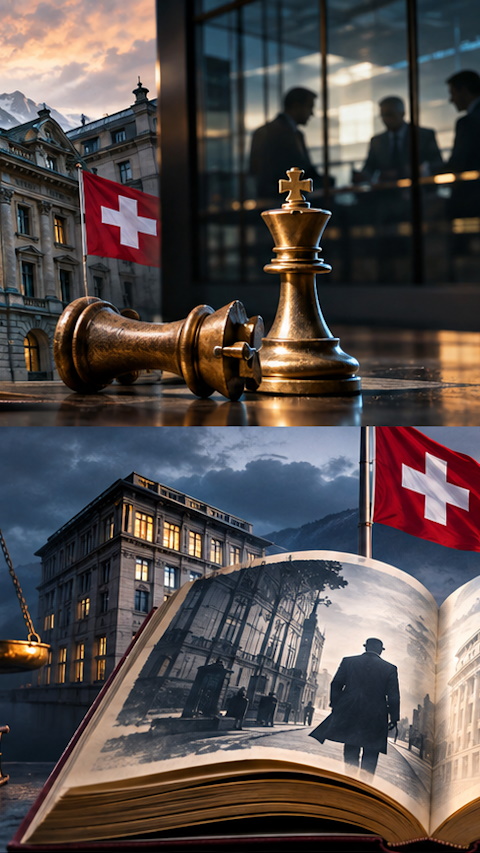
Epilogue
Next in Series: Is Conspiracy Suisse About Credit Suisse or UBS?
In the first eight articles of this series, we had looked at the real events that unfolded after the collapse of Credit Suisse in detail. In this one, we turned to the novel itself and considered what Conspiracy Suisse imagined, what it got right, and what only time will tell. If you want to see how a novelist imagined it all before it happened, start with the questions the book raises. Alternatively, you can read the Emanation Story of the Novel, or About the Author Filia Pater, or the first five chapters of the novel for free.
Series: Credit Suisse, UBS, and Switzerland's Future
Forum Topic: Swiss Banking and the Collapse of Credit Suisse
Tags: Credit Suisse, UBS, allegory
Comments
Leave a comment